Halyard sizing calculator
Enter the sail and the wind. Get the load, the strength it needs, and the Lion rope that clears it.
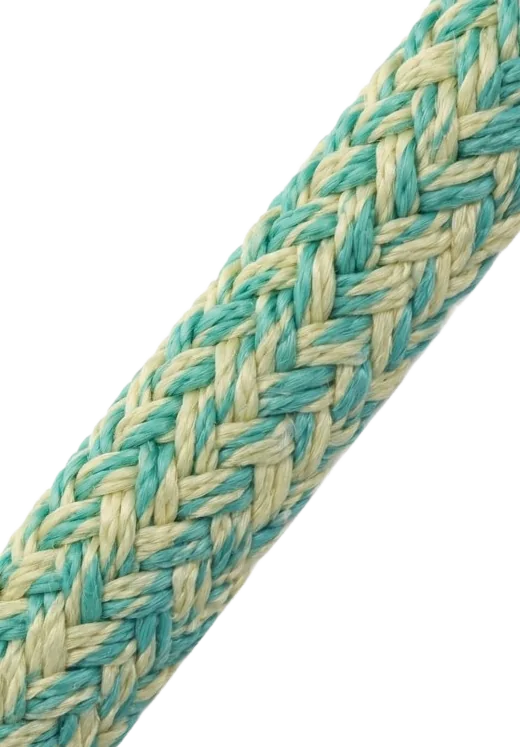
LS Rio 6 mm
The smallest Lion rope that clears the load.
| Diameter | Catalogue break | Spliced | Clears it |
|---|
How the calculator works
Line load
load (kg) = area (m²) × wind² (kn) × 0.02104, with the apparent wind on the sail, as PremiumRopes gives it for sheets and halyards. A 2:1 halyard halves the load on the line.Strength
The working load stays at or under 20% of the rope's breaking load, so the rope must break at 5 times the load (Samson Line Selection Guide).
Creep
Dyneema held under a steady load creeps little below 15% of its break and much less below 10% (Rigging Doctor). A loaded halyard is held for hours, so the rope must break at 6.7 times the load. This usually decides the size.
Splice
A good splice costs about 5 to 10% of strength, so 10% comes off the catalogue breaking load before the comparison (PremiumRopes).
Fit
Go 1 to 2 mm under the clutch's maximum (PremiumRopes), and give Dyneema a sheave at least 8 times its diameter to keep its full strength (RYA).
Before you order
- These are steady-wind figures. Gusts, waves and a shock load on the hoist go well past them.
- For monohulls with soft sails. Not for multihulls.
- No rope or hardware maker publishes a halyard load formula, and Samson's advice is to have your rigger set halyard loads. Use the result as a starting point the loft confirms.
- Catalogue breaking loads are for new rope. Knots, small sheaves, UV and chafe all take strength away.
- Clutch grip and handling often decide the diameter on a small boat, and class rules can set a minimum. Check your class page.
- Only ropes with published breaking loads are sized here: LS Rio and LS Palma. For anything else, ask the loft.
- Matching a Marlow halyard? Lion and Marlow ropes, side by side.